UVX: ultraviolet disinfection at 100+ barrels a minute
UVX started as a small portable village water system that had to work every time. Scaled up, it became a high-flow ultraviolet design that was built and run in the field on oilfield frac water. Conventional UV systems handle gallons per minute. UVX handled more than 4,200, far more effectively and efficiently than conventional UV, and units can be paired to match any flow. It killed 99.9%+ of bacteria, even in produced water too dark to see through, with no toxic biocides. This page is the record of what was built and what it did.
Our roots
It started with safe water for villages
Before the oilfield, UVX powered VillageWater, a solar-powered purifier for remote villages.
Visit VillageWater.net →The core technology
A reaction chamber that multiplies UV's kill rate
UVX's reaction chamber multiplies the pathogen kill rate of ultraviolet light. That's why it needs so little energy, stays compact, and could scale from a village purifier to an oilfield trailer.

One design, many sizes
Single chamber set
One parallel-flow chamber set on a compact skid. For smaller flows: a cooling-tower loop, a small plant, a remote site.
Multiple sets
Two to five sets side by side, sized to a plant's or a process's actual flow, with room to add more later.
Full trailer (UVX 100)
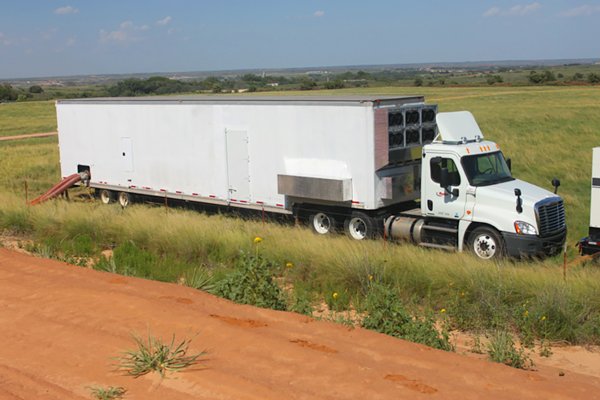
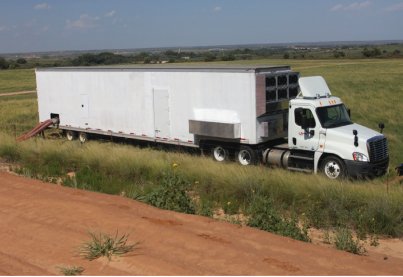
Six sets on one semitrailer: 100+ barrels a minute, mobile, for frac jobs and other high-flow work.
What it did
Field results at oilfield scale
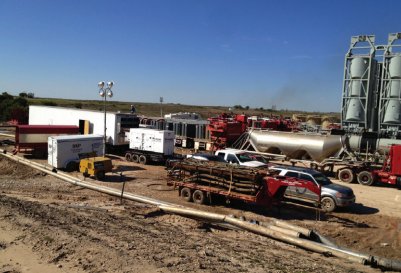
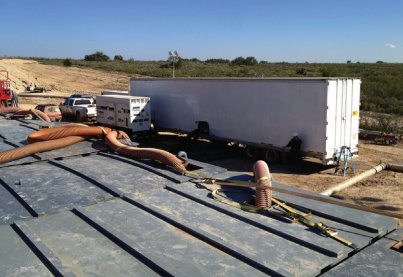
UVX was built for hydraulic fracturing, one of the hardest jobs in water treatment. The water is dirty, the volumes are huge, and the job can't slow down. Bacteria in frac water sour wells and corrode pipe, and the usual fix is tanker loads of chemical biocide. UVX replaced the chemicals with light.
- 99.9%+ bacteria kill, proven in the field
- 100+ barrels per minute from one trailer
- Worked on water you can barely see through: dark, dirty, heavily turbid. Ordinary UV can't treat it
- Ran on oilfield produced water (the briny, oily water that comes back up the well) as well as fresh water
- Did not break down guar or friction reducers in the frac fluid
- Treated water did not break down under high pressure or temperature
- Far more effective and efficient than conventional UV systems
- Sized to the job: a single parallel chamber set for smaller flows, up to six sets on one trailer for 100+ bbl/min
- Non-toxic residual: a small dose of peracetic acid made on board from non-toxic powders replaces toxic biocides
- Cuts the risk of biocide reaching groundwater
- Cost competitive with chemical biocides
Not ordinary UV
UVX vs. conventional UV systems
| Conventional UV | UVX | |
|---|---|---|
| Dirty or dark water | Needs clear water; light can't get through, so the kill rate drops | Ran on produced water you could barely see through, 99.9%+ kill |
| Flow | Gallons per minute per unit; big flows need large banks of reactors | 100+ barrels (4,200+ gallons) per minute from one trailer |
| Efficiency | Baseline | 14× the bacterial kill per cubic foot and 8× the kill per watt of conventional UV* |
| Reliability | One lamp out can mean the system is down | Six parallel chamber sets; a failed lamp's set is isolated and the other five keep running* |
| Scaling | Sized once for one flow | Built from parallel chamber sets: one set for smaller flows, up to six for full trailer flow |
* As reported in Upstream Pumping, May–June 2015 (see In the press).
Why it matters
UV vs. chemical biocide
| Chemical biocide | UVX | |
|---|---|---|
| What's left behind | Chemical residual in the water and at the site | Only a small, non-toxic residual |
| Hauling and storage | Totes or tankers of hazardous chemical | The UV unit and power |
| Effect on frac chemistry | Can react with other additives | No degradation of guar or friction reducers |
| Groundwater risk | Spills and leaks carry biocide | Reduced or eliminated |
| Cost | Ongoing chemical purchases | Competitive, with no toxic biocide to buy |
Cheap insurance for the groundwater. Frac biocides are some of the most toxic chemicals on a well site, and a spill, a leak or a failed casing can carry them into the groundwater that ranchers, towns and families drink. UVX kills the bacteria with light, so there's no toxic biocide to haul, store, spill or leave behind. For any operator who cares about the water around its wells, and the liability that comes with it, choosing UVX is cheap insurance.
Beyond the oilfield
Where the technology fits next
The hard parts of the frac job are high flow, water so dirty you can hardly see through it, and no room for chemicals. Many other water jobs share them. These are the uses UVX's design points toward:
PFAS and tough contaminants
UV paired with other equipment, as an advanced oxidation or reduction stage, is one way treatment trains go after PFAS ("forever chemicals") and other hard-to-break contaminants. UVX's high-flow, modular design could be the UV stage in such a train, sized by pairing units.
Data center cooling
Cooling towers at data centers move huge volumes of water that grow bacteria, biofilm and Legionella. UVX could treat that water at full flow and cut the biocide chemicals, which matters in dry places like Phoenix where every gallon of blowdown counts.
Produced water and reuse
Getting oilfield and industrial water clean enough to reuse instead of trucking and injecting it.
Industrial and agricultural
Cooling water, process water, irrigation and livestock water, anywhere volume is high and chemicals are a problem.
Villages, remote sites and disaster relief
Back to where it started: a portable system for small communities, camps and emergencies. See VillageWater →
Municipal water
Disinfection for city drinking water and wastewater plants at plant-scale flows, without adding to chlorine byproducts.
The field results above are from the frac-water deployment. Municipal and PFAS uses would be new work and would need their own testing against those standards. We list them as directions, not results.
In the press
"Mobile UVX System Disinfects Frac Water to Protect Equipment"
Upstream Pumping, May–June 2015 issue (Well Completion & Stimulation), by Dr. Steve Yencho. It covers the 100 bbl/min single-semitrailer UVX unit, field results over 99.95% kill on freshwater and turbid produced-water fracs running above 90 bbl/min in the Marcellus, Permian and Anadarko basins, operation from 25°F to 110°F with an on-board EPA-method test lab, and a University of Arizona test showing over 99.99999% inactivation.
History
The project
- 2005 — VillageWaterSolar-powered village purifier (see Our roots).
- 3 years in Africa, zero failuresSierra Leone and Ethiopia field trials.
- Scaled upThe same design scaled up with parallel chamber sets, from village-size to 100+ barrels a minute.
- BuildA full-scale, trailer-mounted UVX 100 was built for frac-water disinfection.
- Field deployment (2014–2015), as Liquid RayRan on frac jobs in the Marcellus, Permian and Anadarko basins, on both produced and fresh water. (Liquid Ray site, archived)
- TodayThe design and the results are on record here, and we are selectively considering the next pilot.
Partnering
A small number of serious pilots
We're considering a pilot site or contract with a PFAS treatment project, a data center cooling system, an oil and gas operator with produced water to handle, or a municipal water or wastewater plant. For the right partner, we bring a UVX unit sized to your flow to your site. That is often a single chamber set rather than the full trailer. We run it on your water, and you get the numbers.
UVX is not an off-the-shelf product. Restarting a system is a real investment, so we take on only a small number of funded projects with a defined site and a real flow requirement.
If that describes your project, send a short note with your organization, site, water type, flow rate, timeline and whether pilot funding is in place. We reply to qualified inquiries only.